

Capitalism? The Hot Dog Vendor Is Not the Problem!
Capitalism vs Socialism
In 1986 I was the cofounder of a Mac programmer worker owned cooperative, small systems guild which morphed into Arbor Intelligent Systems in 1988.
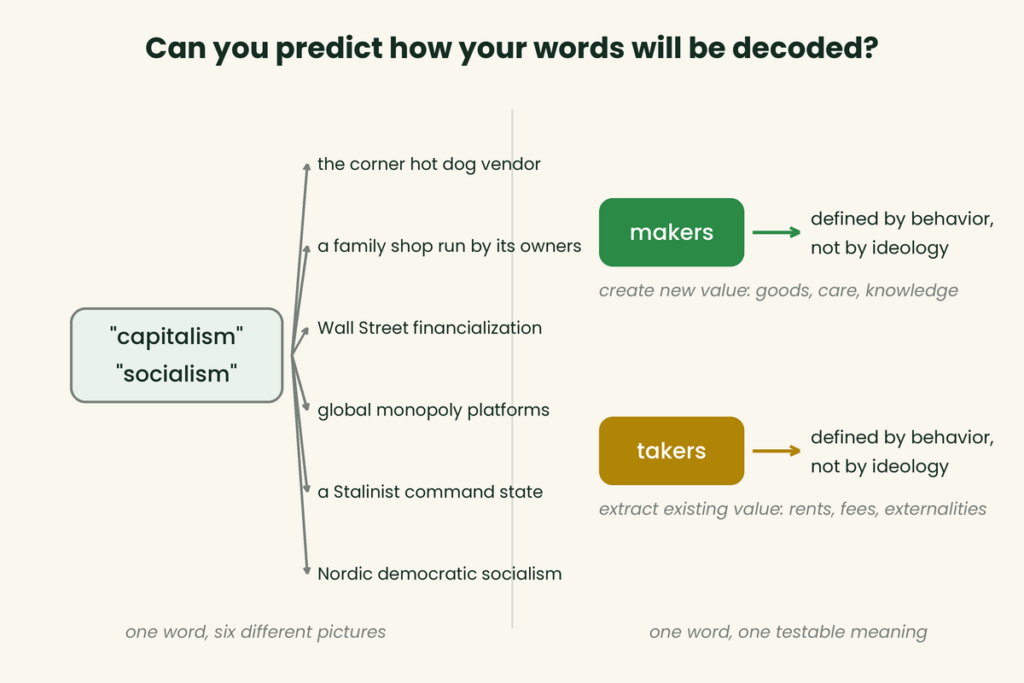
Watch any argument about “capitalism versus socialism” — at a dinner table, on cable news, in a comment thread — and you’ll notice something strange. The two people arguing almost never lose. That’s because they’re almost never talking about the same thing. One person is defending the corner hot dog vendor; the other is attacking a hedge fund. One is warning about Stalin; the other is describing Sweden. The words fly past each other because the words themselves don’t carry a shared meaning.000
This isn’t a debate problem. It’s a vocabulary problem. And economist Mariana Mazzucato — whose book The Value of Everything: Making and Taking in the Global Economy reframes the whole question — points us toward a better set of words.
The hot dog vendor is not the problem
Ask ten people what a “capitalist” is and you’ll get ten answers. To some, the hot dog vendor on the corner is a capitalist: she owns her cart, sets her prices, keeps her profit. But notice what she actually does all day. She buys ingredients, cooks food, serves customers, cleans up, and does it again tomorrow. She owns her tools and performs all of the labor. The same is true for millions of very small businesses — a family bakery, a two-person repair shop, an independent bookstore — where the “owners” are simply people who do all the work.
If your critique of “capitalism” sounds like an attack on her, you’ve already lost your audience — and you should lose it, because she isn’t the problem. She is a producer. In Mazzucato’s language, she sits firmly inside the production boundary: she creates new value that didn’t exist before she showed up with her cart.
What most critics actually object to is something else entirely: the financialization of the economy — enterprises whose “product” is repositioning claims on value that other people created, through fees, rents, interest spreads, buybacks, and speculation. Calling both the vendor and the hedge fund “capitalism” is like calling both a garden and a strip mine “land use.” Technically true, communicatively useless.
Key point: A word that describes both a hot dog vendor and a derivatives desk describes nothing. If a single term covers people who do opposite things to society, the term — not the listener — has failed.
“Socialism” has the same problem in reverse
The word “socialism” is even less predictable. For many Americans, it decodes instantly to a totalitarian, centrally planned Stalinist state: bread lines, secret police, five-year plans. For others, it decodes to Denmark and Norway — market economies with strong public goods, universal healthcare, and unions, consistently ranked among the happiest places on Earth. Still others hear worker cooperatives, credit unions, and community land trusts — forms of shared ownership that are radically decentralized, about as far from a command state as you can get.
Centralized or decentralized. Authoritarian or democratic. State-owned or member-owned. One word is being asked to carry all of it. It can’t.
The communication principle: Choose words whose decoding you can predict. If you cannot reliably predict the picture that forms in your listener’s mind when you say a word, don’t build your argument on that word.
Mazzucato’s reframe: making versus taking
Mazzucato’s central move in The Value of Everything is to stop sorting the economy by ideology and start sorting it by behavior. The question is not “market or state?” It is: does this activity create new value, or does it extract value that someone else created?
She shows how, over the last several decades, our national accounting quietly erased that distinction. Activities that classical economists — left and right, from Adam Smith to Marx — would have called rent extraction got rebranded as “productive.” Finance grew from a servant of the real economy into a self-dealing sector that mostly finances itself, trades existing assets, and collects tolls on the way. When value extraction gets counted as value creation, extractors can present themselves as the engines of prosperity — and demand to be rewarded accordingly.
So the useful vocabulary is not capitalist versus socialist. It is makers versus takers:
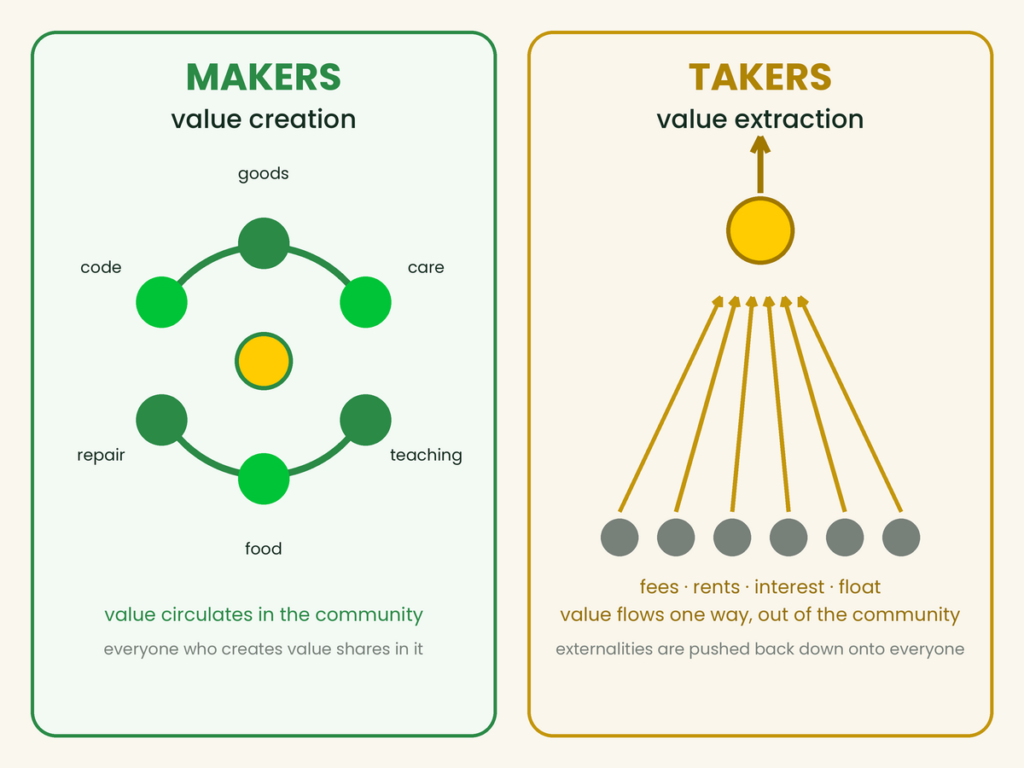
Makers create value society can use: the farmer, the nurse, the teacher, the coder, the vendor, the small manufacturer, the researcher — and yes, the honest lender who finances real production. Makers include plenty of business owners. What defines them is that when they profit, something new exists that didn’t before.
Takers don’t really produce anything for society. They financialize transactions — inserting themselves between value creators and collecting rent on the flow. And critically, they ignore externalities: the pollution, the health costs, the crashes, the hollowed-out towns. Those costs don’t vanish. They land on the public balance sheet, costing society enormous sums, while the gains stay private. Privatized rewards, socialized risks.
One honest caveat: “makers and takers” has itself been used with the opposite meaning — some politicians once used “takers” to describe people receiving public benefits. Which proves the whole point of this post: never assume a shared definition. Define your terms by behavior, out loud, every time. Ours: a taker is anyone whose income comes from extracting value others created while offloading costs onto the public.
A field guide to more predictable words
When we write for podCOIN — and when we talk with neighbors, officials, and skeptics — we try to swap ideological labels for behavioral ones. The behavioral words start conversations; the ideological words end them.
| Instead of saying… | Try saying… | Why it decodes better |
|---|---|---|
| capitalism / socialism | value creation / value extraction | Describes what’s happening, not whose team you’re on |
| capitalists | makers and takers (defined by behavior) | Separates the vendor from the hedge fund |
| anti-corporate | anti-extraction | Leaves room for businesses that genuinely produce |
| redistribution | keeping value where it’s created | No one thinks their own community deserves less of what it makes |
| nationalize / privatize | community-owned vs. absentee-owned | Ownership distance is what people actually feel |
| “the free market” | markets that count their real costs | Puts externalities back in the price where they belong |
Why this matters to us
This vocabulary isn’t academic for us — it’s a design specification. The podCOIN ecosystem is built so that a local learning economy behaves like the left side of the diagram: members earn by teaching, making, repairing, and helping; the ledger is transparent; the currency is deliberately non-purchasable with no fiat off-ramp, so it can’t be financialized; and our compute infrastructure is community-owned and solar-powered, with the energy meter visible to everyone. We call this a Community Owned Information Network — because the alternative, renting our information networks from distant takers, is exactly the extraction Mazzucato warns about.
A rising tide only floats everyone’s boats if the water stays in the harbor. Extraction drains the harbor and calls it growth.
Try it this week: The next time someone starts a capitalism-versus-socialism argument, decline the frame. Ask one question instead: “Is this activity making new value, or taking value someone else made?” Watch how quickly people who thought they disagreed discover they don’t.
Further watching: Mariana Mazzucato’s talks on value creation and extraction are an excellent starting point — including her discussion of who really creates economic value, available on YouTube. Her book The Value of Everything develops the full argument.